

Support your dog’s nervous system-not just their ears.
Behavior-informed sound environments designed to help dogs to settle, rest and cope with stress- designed by behavioral scientists, not playlist curators.
Access requires a Think Wave account. Cancel anytime.
Why an account is required
Think Wave audio is structured into progressive levels and use cases. An account allows access to the full sound library, updates, and appropriate progression.
Flexible access to Think Wave’s soundscapes for dogs. Best for short-term needs, trying Think Wave for the first time, or occasional use.
Equivalent to $1.67 per month Full access to Think Wave’s growing library of sound environments for dogs, with new soundscapes added over time. Best suited for ongoing use and long-term routines.
ThinkWave
Sound environments designed for dogs
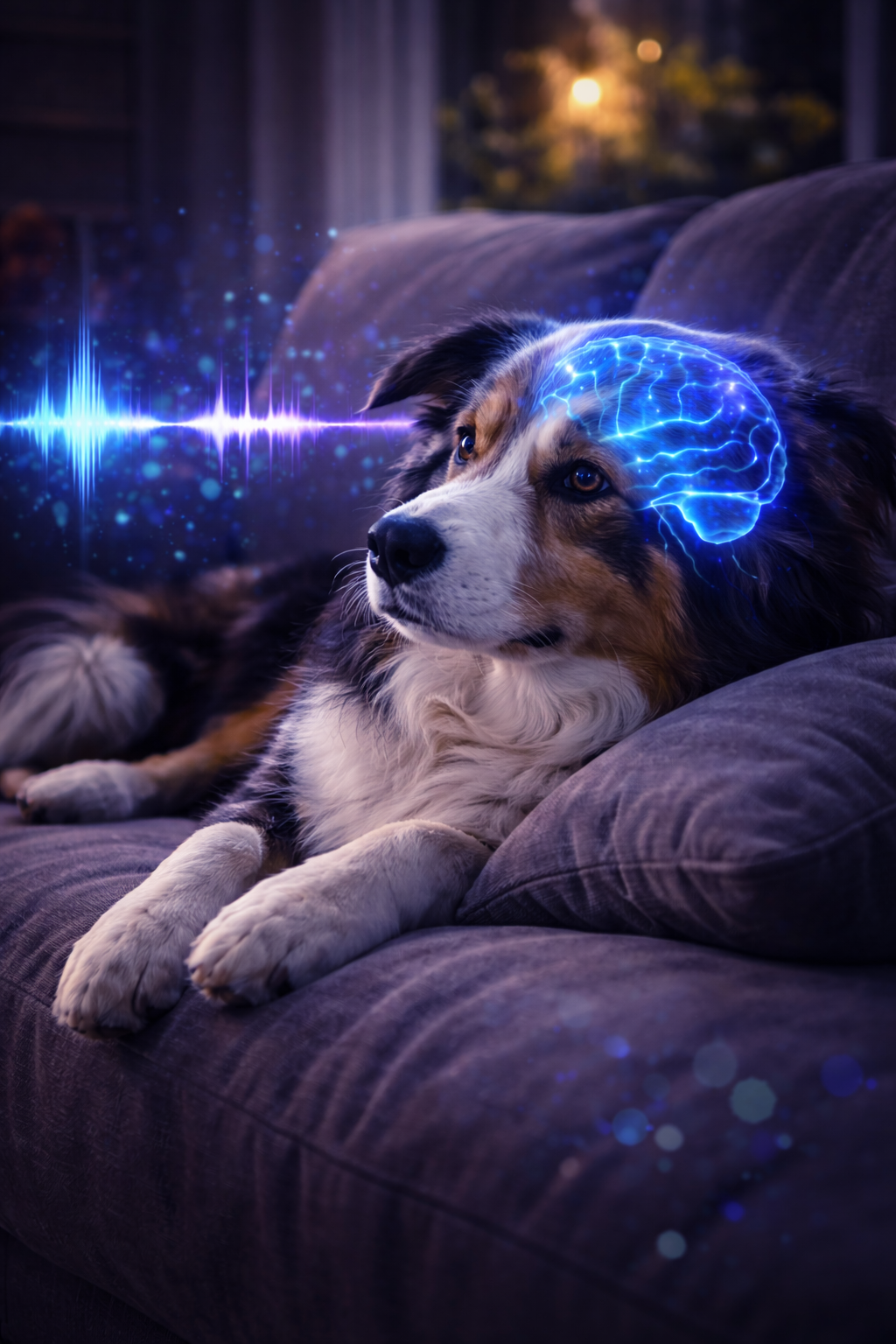
Think Wave creates carefully designed soundscapes to support calm, rest, and emotional comfort in dogs. Built with behaviour in mind, Think Wave is a simple, non-invasive way to shape your dog’s environment through sound.
What is Think Wave?
Many behaviour challenges in dogs and cats are not training deficits or compliance issues.
They are the result of chronic or situational dysregulation of the nervous system.
ThinkWave was developed to address behaviour at its neurological foundation by providing structured, behaviour-informed audio designed specifically for animal auditory processing — not human preference.
Think Wave is not music, white noise, or generic “calming sounds.”
It is a curated library of over 50 hours of targeted audio, developed using principles of behavioural science, auditory processing, and arousal modulation, with the goal of supporting reduced sympathetic activation and improved capacity for learning and recovery.
The Think Wave system includes multiple structured audio categories, including:
Audio designed to reduce baseline anxiety and hyperarousal
Sound structures intended to interrupt sustained fixation and over-reactivity
Low-frequency background layers to support rest and decompression
Graduated sound exposure programs for desensitisation to environmental stimuli
Carefully layered sound overlap to support early puppy socialisation without sensory flooding
Think Wave is intended for use alongside behaviour modification and training programs, during periods of decompression, crate rest, recovery, environmental transitions, and exposure to high-stress stimuli such as noise events, visitors, or novel environments.
Think Wave does not replace training, behaviour plans, or professional intervention.
It supports these processes by helping create the physiological conditions necessary for learning, emotional regulation, and behavioural change.
Designed With Behaviour in Mind
Think Wave was developed under The Cognitive Canine, a behaviour-focused training approach that recognises how environment, stimulation, and predictability influence a dog’s emotional state.
Sound is part of that environment.
Think Wave soundscapes are designed to:
Reduce sudden auditory contrast
Create consistent background noise
Support relaxation and rest
Be safe, passive, and easy to use

When to Use Think Wave
Think Wave can be used during:
Sleep and rest periods
Crate time
Alone time or departures
Noisy environments
Changes in routine

Simple to Use
Play through any device or speaker
No special equipment required
Use at low, comfortable volume
Listen anytime, anywhere
Once subscribed, all soundscapes are available instantly.

$2.34
Monthly
Flexible access to Think Wave’s soundscapes for dogs. Best for short-term needs, trying Think Wave for the first time, or occasional use.
Includes
Full access to all Think Wave soundscapes
Ideal for short-term or situational use
Helpful during temporary stressors or routine changes
Play on any device or speaker
No long-term commitment
Cancel anytime
$1.67
per month
$20
Yearly
Ongoing access to Think Wave’s full sound library, designed to support consistent routines and long-term calm environments for dogs.
Includes
Full access to all Think Wave soundscapes
Designed for long-term, daily use
Supports predictable routines and environments
New soundscapes added over time
Best value for multi-dog or ongoing households
Play anytime, anywhere
Your Questions, Answered
What is Think Wave?
ThinkWave is a library of behaviour-informed audio designed to support nervous system regulation in dogs and cats. The audio is structured using principles from behavioural science, auditory processing, and arousal modulation, with the goal of supporting reduced physiological arousal and improved capacity for learning and recovery.
How is Think Wave different from music or white noise?
Music and white noise are primarily designed around human auditory perception and emotional preference.
Dogs and cats differ substantially from humans in hearing range, sensitivity, and sound processing, particularly in higher frequencies and temporal resolution [1,2]. Think Wave audio is designed specifically for animal auditory systems, using structured frequency ranges, sound layering, and progression levels intended to influence arousal and sensory processing rather than provide entertainment.
Is there scientific evidence that sound can influence behaviour?
Yes. A growing body of research across species demonstrates that auditory input can influence:
Autonomic nervous system activity
Stress hormone levels
Arousal and attention
Behavioural responses to environmental stimuli
In dogs, controlled auditory environments have been shown to influence stress-related behaviours and physiological markers such as cortisol levels [3,4]. Similar effects have been documented across mammals, including modulation of sympathetic and parasympathetic activity through auditory stimulation [5].
Sound alone is not a treatment for behavioural disorders, but it can function as an environmental modifier that supports regulation.
No.
Think Wave does not diagnose, treat, or cure anxiety, aggression, or behavioural disorders. Behavioural conditions are multifactorial and often require comprehensive assessment, training, environmental management, and sometimes medical intervention [6].
Think Wave is designed to support physiological regulation, which may help some animals better tolerate stressors and participate more effectively in behaviour modification.
Does Think Wave treat anxiety or aggression?
Can Think Wave replace training or behaviour therapy?
No.
Evidence-based behaviour change requires structured learning, reinforcement history, and appropriate environmental contingencies [7]. Sensory interventions alone are insufficient.
Think Wave is intended to be used alongside behaviour modification and training, not as a replacement.
What behaviours is Think Wave commonly used to support?
Think Wave may be used as a supportive tool in contexts involving:
Anxiety and hyperarousal
Reactivity and difficulty settling
Noise sensitivity (e.g. fireworks, storms)
Frustration-related behaviours
Difficulty with rest, recovery, or decompression
Environmental transitions and novelty
Early puppy socialisation when applied conservatively
These uses align with research demonstrating that reduced baseline arousal improves learning, behavioural flexibility, and emotional resilience [8,9].
Think Wave may be incorporated during:
Behaviour modification sessions
Decompression and rest periods
Crate rest and recovery
Environmental transitions
Predictable stressors (e.g. noise events)
Sound exposure should be gradual, at volumes appropriate for the species and individual. Forced exposure or flooding is contraindicated and can increase stress and sensitisation [10].
How should Think Wave be used?
Not necessarily.
Animals vary in sensory sensitivity and neurological thresholds. Some individuals may not benefit from auditory input or may require careful, incremental introduction [11]. Animals with significant behavioural concerns should be evaluated by a qualified professional before introducing new interventions.
Is Think Wave suitable for all dogs and cats?
Yes, when used appropriately.
Early socialisation research indicates that controlled, low-intensity exposure to environmental stimuli during sensitive periods can support adaptive behavioural development [12]. Think Wave’s low-frequency background and layered sound programs are designed to support exposure without sensory overload, when paired with appropriate socialisation practices.
Can Think Wave be used with puppies?
Think Wave is evidence-informed, drawing from established research in:
Behavioural science
Auditory processing
Stress physiology
Learning theory
It is not a stand-alone therapeutic intervention and should not be represented as such. It is best understood as a supportive environmental tool within a broader evidence-based behaviour plan.
Is Think Wave evidence-based?
Summary Statement
Think Wave is a behaviour-informed auditory support system designed to help create physiological conditions that may improve an animal’s capacity to cope, learn, and recover — when used appropriately and alongside evidence-based behaviour practices.
References
Heffner, H. E. (1998). Auditory awareness. Applied Animal Behaviour Science, 57(3–4), 259–268.
Strain, G. M. (2011). Canine and feline sensory abilities and dysfunction. Veterinary Clinics of North America: Small Animal Practice, 41(4), 641–659.
Kogan, L. R., Schoenfeld-Tacher, R., & Simon, A. A. (2012). Behavioral effects of auditory stimulation on kenneled dogs. Journal of Veterinary Behavior, 7(5), 268–275.
Bowman, A., Dowell, F. J., Evans, N. P., & Scottish SPCA. (2015). The effect of different genres of music on the stress levels of kennelled dogs. Physiology & Behavior, 136, 47–53.
Thaut, M. H., & Hoemberg, V. (2014). Handbook of neurologic music therapy. Oxford University Press.
Overall, K. L. (2013). Manual of clinical behavioral medicine for dogs and cats. Elsevier.
Skinner, B. F. (1953). Science and human behavior. Macmillan.
McEwen, B. S., & Gianaros, P. J. (2010). Central role of the brain in stress and adaptation. Annals of the New York Academy of Sciences, 1186, 190–222.
Sapolsky, R. M. (2004). Why zebras don’t get ulcers (3rd ed.). Holt Paperbacks.
Levine, E. D., Ramos, D., & Mills, D. S. (2007). A prospective study of two self-help CD based desensitisation and counter-conditioning programmes. Applied Animal Behaviour Science, 109(2–4), 211–228.
Beerda, B., Schilder, M. B. H., van Hooff, J. A. R. A. M., de Vries, H. W., & Mol, J. A. (1997). Manifestations of chronic and acute stress in dogs. Applied Animal Behaviour Science, 52(3–4), 307–319.
Freedman, D. G., King, J. A., & Elliot, O. (1961). Critical period in the social development of dogs. Science, 133(3457), 1016–1017.
Contact Us!
Flexible access to Think Wave’s soundscapes for dogs. Best for short-term needs, trying Think Wave for the first time, or occasional use.
Equivalent to $1.67 per month Full access to Think Wave’s growing library of sound environments for dogs, with new soundscapes added over time. Best suited for ongoing use and long-term routines.